




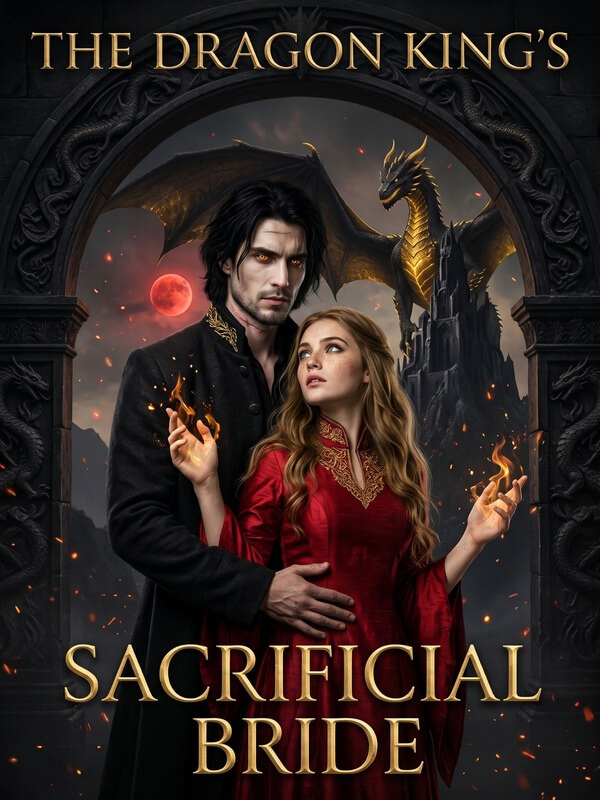
Chapter 1 The Lottery
- Tamsin
- The moon comes up red over Hollin's Ford, and everyone in the square pretends not to look at it.
- It sits on the shoulder of the mountains like a coal someone dropped and forgot to pick up. The color runs down into the river and turns the mill wheel the color of rust. The old women say a Blood Moon is the dragons' moon, that they can see by it, that on this one night every five years the Dragon King looks down from his mountain and counts us.
- I don't believe that. I'm a herbalist's granddaughter. I believe in willow bark and clean water and boiling your knives.
- But I don't look at the moon either.
- There are forty-one of us standing in front of the temple steps. Every unmarried woman in Hollin's Ford between seventeen and twenty-five, in our best dresses, with our hair brushed, as if the dragon cares. Behind us, the rest of the village stands in a silent half circle with lanterns. Behind them, the dark.
- On the temple steps there's a table, and on the table there's a bronze urn as old as the Accord, green at the handles. Father Anselm stands beside it in his gray robe, reading the words of the Ashen Accord in the voice he uses for funerals. Beside him stands Lord Warden Edric Hask, who rode in from his hall at Greystoke this afternoon with twelve soldiers and a fur collar too warm for the season.
- And beside the Lord Warden, holding the urn steady with one gloved hand, stands his son.
- Corwin Hask is twenty-four, and he is beautiful in the way a well-made knife is beautiful. Fair hair, a straight nose, a mouth that smiles too easily. Every girl in the Marches used to want him to look at her. I used to be one of them, for about a week, when I was fifteen.
- He's looking at me now.
- I look back. I don't smile. Two months ago, at the Midsummer dance, he put his hand where I hadn't invited it, behind the barley stacks, and when I told him to take it away he laughed and didn't. So I slapped him hard enough to split his lip, in front of his friends.
- He's been very polite to me ever since. That's what frightens me.
- * * *
- "In the three hundredth year of the Ashen Accord," Father Anselm reads, "by the grace of the Dawn and the mercy of the King, Hollin's Ford gives one daughter to the mountain, that the fire may sleep and the fields may grow."
- He doesn't say that the dragons may eat. Nobody ever says it. Nobody needs to.
- Beside me, Bess Miller is crying without making a sound. On my other side, Annie Cooper is holding my hand so tightly that her nails are cutting my palm. I let her. The Coopers have five daughters, and three of them are standing in this line.
- Every five years, one village in the Marches is chosen by lot at Midsummer. Every five years, on the night of the Blood Moon, that village chooses a bride. She rides to the Ashen Gate. She waits there at sunset on the third day. A dragon comes down out of the mountains and takes her away.
- She never comes back.
- Fifteen years ago, it was Hollin's Ford, too. I was six. The bride was Agnes Fenwick, who used to give me sugared violets from her mother's shop and let me sit on the counter. I remember her in the red dress, climbing into the cart, turning round to wave at her mother. I remember that she was smiling, because she didn't want her mother to see her afraid.
- I've thought about that smile for fifteen years.
- * * *
- The Lord Warden puts his hand into the urn.
- The whole square holds its breath. I can hear the river. I can hear the creak of the mill wheel and a dog barking somewhere across the water and the thin hiss of the lanterns. I can hear Annie Cooper praying under her breath, not me, not me, not me, and I'm ashamed of how much I'm saying the same words in my own head.
- Lord Hask stirs the slips of paper. He takes his time. He looks at the crowd while he does it, the way a man looks at a field he owns.
- Then he takes his hand out, and passes the folded slip to his son.
- That's wrong. It's always the Lord Warden who reads the name. Everyone knows that. I see Father Anselm frown, and open his mouth, and close it again.
- Corwin unfolds the paper. He doesn't look down at it. He doesn't need to.
- He looks at me.
- "Tamsin Reed," he says.
- * * *
- For a moment there is no sound at all.
- Then Annie's hand goes slack in mine, and she starts to sob, from relief, and turns her face into her sister's shoulder. Someone at the back of the crowd says oh no, oh, the poor lamb. Someone else says the herbalist's girl, as if they need to explain to each other who I am. Bess Miller sits down on the cobbles in her good dress, because her legs have stopped holding her up.
- I don't move.
- I notice everything, sharp and clear, the way you are just after you cut yourself and before it starts to hurt. The cold of the cobbles through the thin soles of my shoes. The smell of lantern oil. A moth in the light above Father Anselm's head. Corwin's face, perfectly grave, perfectly sorry, and his eyes laughing.
- He rigged it.
- I know it the way I know the difference between hemlock and wild parsley. I don't know how. A slip palmed in his glove. A second urn. All forty-one slips with my name on them. It doesn't matter how. He's the Lord Warden's son, and the Lord Warden passed him the paper, and nobody in this square is going to ask to see it.
- I could shout. I could say, show me the slip, show everyone. And Lord Hask would say that grief had disordered me, and his soldiers would walk me to the cart a little more roughly than they need to, and Nan would have to watch.
- So I don't shout.
- I lift my chin, and I step out of the line, and I walk up the temple steps the way Agnes Fenwick walked to the cart. Not fast. Not slow. I stop in front of the table and look Father Anselm in the eye, because he's known me since I was born and I want him to have to look back.
- He does. His eyes are wet.
- "The Dawn keep you, child," he says.
- "I'd rather it kept me here," I tell him.
- * * *
- They give me the night at home. That's the custom. The cart leaves at dawn.
- Nan doesn't cry. She makes tea, the way she does when someone comes to the door with a fever or a broken arm or a baby coming too early, and she puts the cup in my hands and folds my fingers round it.
- My brother Wil cries enough for all three of us. He's eleven, and he's spent the last year telling everyone he's too old to cry, and now he sits on the end of my bed in his nightshirt with his face screwed up and his fists clenched and says he'll go to the mountain himself and kill the dragon with Nan's bread knife.
- "You'll stay here and look after Nan," I tell him. "Who's going to dig the comfrey bed if you go and get yourself eaten?"
- "You're going to get eaten."
- "Probably," I agree. "But I'm going to give it terrible indigestion."
- He laughs, wet and furious, and then cries harder, and I hold him until he falls asleep across the foot of the bed with his mouth open.
- When he's asleep, Nan sits down beside me. She takes something out of her apron pocket and puts it in my palm.
- It's my mother's stone.
- I know it the way I know Nan's hands. A teardrop of something smooth and dark, the size of my thumb, with a hole bored through the narrow end for a cord. It looks black, until you hold it near the fire. Then it shows a red-gold deep inside, like an ember under ash. My mother wore it every day of her life, Nan says. I don't remember. I was six when she died.
- "I thought you'd sold it," I say. "Last winter. When the roof went."
- "I'd have sold the roof first." Nan takes the stone from my hand, and loops the cord over my head, and tucks the stone under the neck of my shift so it lies against my skin. It's warm. It's always warm.
- Then she takes both my hands in hers. Her fingers are thin and knotted and strong.
- "Listen to me, Tamsin," she says. "Wherever they take you. Whatever happens. You never let them see your hands in the fire."
- It's the first rule I ever learned. Before my letters. Before which mushrooms kill you. When I was four I took a loaf out of the bread oven with my bare hands, and Nan saw that I didn't burn, and she slapped me so hard my ears rang. It's the only time she ever hit me. Then she sat on the kitchen floor and held me and shook.
- Never let them see. People in the Marches burn witches. People in the Marches burn girls for less.
- "Nan," I say. "Why does it matter now? I'm going to be eaten by a dragon."
- She looks at me. Her face does something I've never seen it do, and I don't understand it.
- "Promise me," she says.
- So I promise.
- * * *
- At dawn, the cart is waiting in the square. It's painted red, like my dress, and hung with dried flowers, and there are two Dawn priests sitting on the bench beside the driver, looking at their knees.
- Half the village has come out to watch. They stand in their doorways with their arms folded against the cold, and when I come across the square with Nan on one side and Wil on the other, nobody says anything, and the women touch their foreheads as I pass.
- The Lord Warden's soldiers are mounted beside the cart. Six of them. My escort, all the way to the Ashen Gate.
- And at their head, on a tall gray horse, in a riding cloak lined with fox fur, is Corwin.
- I stop.
- He leans down from the saddle. Close enough that I can smell the clove oil on his hair. Close enough that nobody else can hear him.
- "You could have been mine, Tamsin," he says softly. "You could have had a house with glass in the windows and a girl to do your washing. Now look at you."
- He smiles. It's a very fine smile.
- "Now you'll be ash."